
Website Redesign: When It's Really Worth It
Published on 14 Sept 2026
For a long time, I had two WordPress websites. One for Creator Academy, my training platform, and one for my video production business. I had built both of them entirely myself. I spent hours on them, I poured sweat and tears into them. And yet both sites were as basic as they come.
Let's be honest, building on WordPress is very easy, but you have to make compromises. You can't have everything. And I'm a bit stubborn, which caused me a lot of problems. So I spent hours and hours, sometimes just looking for the right button.
But it wasn't building the project that cost me the most. It was the maintenance. Between plugin updates, the bugs to fix afterwards and publishing content, my two sites easily took up one to two days a week. Two days I wasn't spending filming, editing or selling.
In the end, I rebuilt everything. Not touched up: rebuilt. Since then, maintenance time has melted away, and user feedback has changed. People tell me the site looks much more professional. Some people who already knew me brought it up unprompted, which never happened with the old version.
I'm telling you this because the situation is the same whether you sell training courses, concrete screeds or beauty treatments. A website that costs you time and no longer reflects who you are costs you money, even when it's online and everything seems to work.
This article answers three questions: how to tell whether your website really needs a redesign, how to avoid losing your search rankings along the way, and when it's better not to rebuild anything at all.
Nobody redesigns their website because they find the blue of a button a bit dull. The real trigger almost always lies elsewhere. Here are the signals we see most often with our clients.
Your site is sluggish on mobile. Open it on your phone, on 4G, not on Wi-Fi. If the first image takes more than three seconds to appear, you lose part of your audience before they've even read your name. It's the most common problem on sites built around 2019, usually on a CMS with a dozen plugins piled up over time.
The technology is no longer maintained. That's exactly what happened to me when a plugin update clashed with one of the plugins in my WordPress theme. At that point, the site crashed and the database had to be completely rebuilt.
Despite my attempts to contact the creator of the WordPress theme I had paid for, I ended up on my own, having to fix everything.
As long as nothing breaks, you don't notice a thing. The day it breaks, you find out there's no one left to fix it.
Your search engine rankings are slipping. Not a collapse, a slow erosion. You were on the first page for your trade and your town, now you're on the second. Often, it isn't your content that has aged, it's the site's technical structure that hasn't kept up.
Your form produces nothing. If you get fewer than one enquiry a month even though traffic is decent, the problem isn't visibility but conversion. A rock-bottom conversion rate is almost always a user experience problem: a confusing journey, information that can't be found, an off-putting form.
Your offering has changed, your site hasn't. You've added a service, dropped a line of business, changed target audiences. Your site, meanwhile, is still selling what you did four years ago.
Your site no longer looks like what you show elsewhere. Your Instagram posts have a clear visual identity, your videos are well shot, and your site looks like it belongs to another company. That mismatch costs you trust: visitors arriving from your social media feel as if they've switched brands along the way.
And one last signal, less visible than the others: time. If maintaining your site takes up several hours every week, whether it's you or someone on your team, do the maths over twelve months. The real cost of your current site probably already exceeds that of a redesign.
We sell websites, so what follows may seem counter-intuitive. But an unnecessary redesign is expensive and fixes nothing, and we'd rather say so before the quote than after.
Your website is new. Barring a major disaster, a recent site has no structural problem. If it isn't delivering results, the cause lies elsewhere, and rebuilding it will only reset the counter to zero.
The problem is in the content, not the structure. This is the most common case. Sections that don't cover the right topics, copy that describes your trade instead of answering your clients' questions, no page dedicated to your main services. Redoing the design won't change anything: the same copy in a prettier box delivers the same performance. Rewriting costs ten times less than rebuilding.
You have no traffic at all. If nobody comes, the root of the problem isn't the site, it's the lack of visibility. SEO, social media, word of mouth, advertising. A new site with no audience is still a site with no audience.
The rule is simple: if you can't name exactly what's wrong, don't redesign yet. Do an analysis first.
Once the decision is made, you still have to choose the scale. Three criteria are enough to decide.
The state of the technical foundation. If the base is sound and recent, you can redo the look and reorganise the navigation without rebuilding everything. If it relies on abandoned building blocks, every piece of work will cost more than the last.
The extent of the structural changes. Changing the colours and photos is a partial redesign. Changing the site's organisation, navigation and content is a rebuild, even if you keep the same CMS.
The budget. The real question isn't the amount on the invoice, it's what you pay every year to maintain what you have. A partial redesign on a fragile base often amounts to postponing the expense by eighteen months, with interest.
If in doubt, here's a rule of thumb: if you're hesitating between the two, it's probably because you no longer trust the foundation. That's already an answer.
This is the most common mistake, and the most expensive one: treating the redesign as a standalone project. Redoing the site without touching anything else is like redoing the facade while keeping the old furniture.
People almost never discover a company through its homepage. They first see a video, a post, a recommendation, then they go and check the website. What they're looking for at that moment is confirmation. If the site tells a different story, with a different tone and different colours, that confirmation doesn't come.
We regularly see the same picture: a flawless new website, a YouTube channel abandoned for two years, and an Instagram account from another era. Each of the three is fine on its own. Together, they give the impression of a company with no strategy.
In practice, a well-run redesign comes with three things.
Video on the site. A short introduction on the homepage, filmed client testimonials, a feature on your trade. A user who sees and hears you makes up their mind faster than one who reads your words. This is even more true in businesses where trust matters more than price.
A shared visual identity. The same colours, the same typography and the same tone on the site, the videos and social media. This isn't vanity: it's what makes you recognisable from one channel to the next.
Social media that tells the same story. The site sets the scene, social media nurtures the relationship. If the two don't say the same thing, visitors go with the one they like least.
That's why our agency doesn't just build websites. A website, videos and a social media presence designed together cost less and work better than three services ordered separately from three providers who don't talk to each other.
There's no need to roll out a nine-phase methodology: in reality, a redesign comes down to four stages.
Analysing the existing site. We review and audit what works before deciding what to throw away. Which URLs get traffic, for which search queries, which ones serve no purpose. This phase is the one most often rushed, and it's the one that determines whether you keep your search rankings.
Objectives and the specifications. This is the time to say what the new site needs to achieve, and for whom. Clear objectives aren't "make it more modern", they're, for example, doubling quote requests, selling online, or reducing support calls. These objectives determine the feature list, the structure of the sections and the copy, which are prepared now and not at the end. In practice, it's almost always waiting for content that drags a project out, never the technical work.
Designing and developing the website. Design, user experience, optimisation, integration. The visible part, and paradoxically the quickest when the two previous phases have been done properly.
Launch. Redirects, checks, performance monitoring. See the next section, because this is where everything is decided.
It's our clients' number one fear, and it's well founded. A poorly prepared redesign can wipe out, overnight, rankings built up over years. The good news is that it's entirely avoidable, provided you deal with it before and not after.
Take stock of what exists before touching anything. In Search Console, note which URLs get impressions and clicks, and for which search queries. This record is your baseline. Without it, you won't even know what you've lost.
Keep the URLs that work. If a section ranks well, the default rule is not to change its URL. A URL that moves for no reason is authority thrown away.
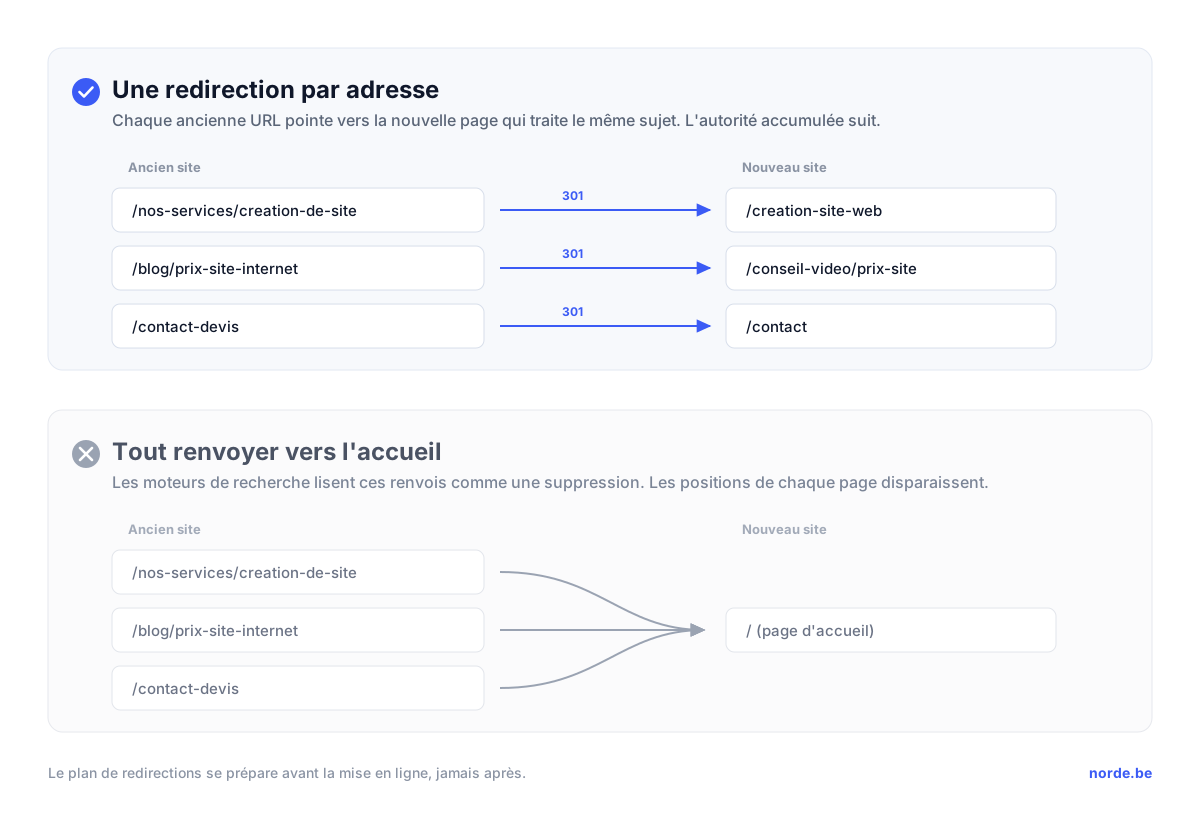
Prepare a line-by-line redirect plan. Every old URL that disappears must point to its closest equivalent, using a permanent redirect, known as a 301. One by one, not all to the homepage: a mass redirect to the homepage is read by search engines as a deletion, and you lose everything.
Don't throw away content that's working for you. A poorly presented old article that brings you users every month is worth more than a beautiful empty page. You revise it, you optimise it, you don't delete it.
Monitor the weeks that follow. Google takes several weeks to rediscover a redesigned site. A slight, temporary dip is normal. A sharp drop on a specific URL isn't, and is usually fixed by adding the redirect that was forgotten.
One last point, which isn't technical but matters just as much: make sure you remain the owner of everything. Domain name, hosting, admin access, analytics tools. Very often, the first headache of a redesign is an unreachable former provider who holds access that nobody else has.
A redesign generally costs the same as building a new site, sometimes a little less when existing content can be reused, sometimes a little more when you have to deal with the site's history, carry out an audit and manage a substantial redirect plan.
The detailed price ranges, by type of site and by cost item, are in our article on the cost of a website. We won't repeat them here.
The only thing to add, specific to a redesign: ask for the redirect plan to be explicitly included in the quote. If it isn't there, there's a good chance it won't be done.
I often think back to those one to two days a week. It's not an expense that shows up on an invoice, so you never count it. But it's the heaviest one.
A successful redesign isn't measured only by how it looks. It's measured by the time you no longer spend on it, by the questions your clients no longer ask you because the answer is online, and by that sentence you eventually hear: it looks much more professional.
If you recognise your situation in the signals at the start, let's talk. One conversation is usually enough to know whether to redesign, rewrite, or do nothing for now.
A redesign means rebuilding an existing website rather than touching it up. Depending on the case, it covers the design, the structure of the sections, the content, the underlying technology, or all four at once. What sets it apart from a simple update is that you start from the company's objectives, not from what already exists.
The budget is in the same range as building a new site: expect to pay from 2,000 euros for a showcase website, more as soon as there's online selling or custom features. A redesign can cost a little less than a new build when the content can be reused, a little more when you have to deal with the site's history and prepare a substantial redirect plan. The breakdown by cost item is in our article on the cost of a website.
Allow four to eight weeks for a showcase website, longer for an e-commerce site or a custom project. These timelines assume your content is ready: in practice, it's almost always waiting for copy and photos that drags a project out.
Not necessarily, but it's often a good opportunity. Modern technologies don't have the same requirements as a site from the 2010s, and hosting can become significantly cheaper. What matters is that the account is in your name.
Yes, and it's strongly recommended. Your domain name carries the age and reputation your site has built up. You only change it for a real reason, such as a change of company name.
Not if the redirects are prepared before launch and the URLs that rank are kept. A slight dip for a few weeks is normal, while the site is rediscovered. A lasting drop is a sign of a missing redirect.
No. You keep and improve what works, rewrite what no longer matches your offering, and add what's missing. Rewriting everything on principle wastes time and sometimes costs you rankings.
It's possible, and sometimes preferable for a large site. You start with what brings in clients, then deal with the rest. The downside is a period when the site mixes two styles, which doesn't suit a small showcase website.
A redesign is only one of the possible answers, and rarely the first. Start by checking in Search Console which search queries you already appear for: a position between 11 and 20 means the work is almost done and that expanding the relevant section is often enough. Next come loading speed on mobile, content that genuinely answers your clients' questions, and links from other sites. A redesign becomes relevant when the technical structure is what's holding you back, not before.
If the deletion is recent, your hosting provider usually keeps automatic backups for anywhere from a few days to a few weeks: that's the first thing to check, and you need to act fast. If the site is permanently lost, some of the content can often still be recovered from web archives, which at least lets you retrieve the copy and the list of old URLs, essential for setting up the redirects. This scenario is also why you should hold your own hosting and domain name access.

How Much Does a Website Cost? Real Prices in 2026

Corporate Video: Interview, Storytelling or Institutional Film?

Community Management: How Can You Really Get Views on Social Media?