Short answer: yes. Long answer: no.
I know what you're thinking: I probably forgot to take my meds before sitting down at the keyboard. But let me explain why, in 2026, you should avoid using AI for your ads.
And no, today we won't talk about ethics, data theft or humans being replaced by machines. Even though those topics are just as important, today we're going to look at the purely marketing.
The real question about ads made with AI
Why do you want to use artificial intelligence to make your ad?
Usually, the answer comes down to a single word: the cost.

It's the first argument that comes to mind. We're promised faster, better, smarter work (not contractually binding, of course). But is that really the case? And above all, would you be willing to pay the hidden price?
The myth of saving time (and money)
Take the case of a video ad. To make it yourself (and therefore fire your ad agency), you'll have to use high-end models like Veo3, Kling or Sora. Forget the low-end models: making an ad with extras who have three arms doesn't really help you sell.
The problem? These platforms run on credits. A subscription at 200 euros a month gives you a set number of tokens. "It's still cheaper than a film crew," you'll tell me.
But that's without counting on the scourge of generative AI: randomness.
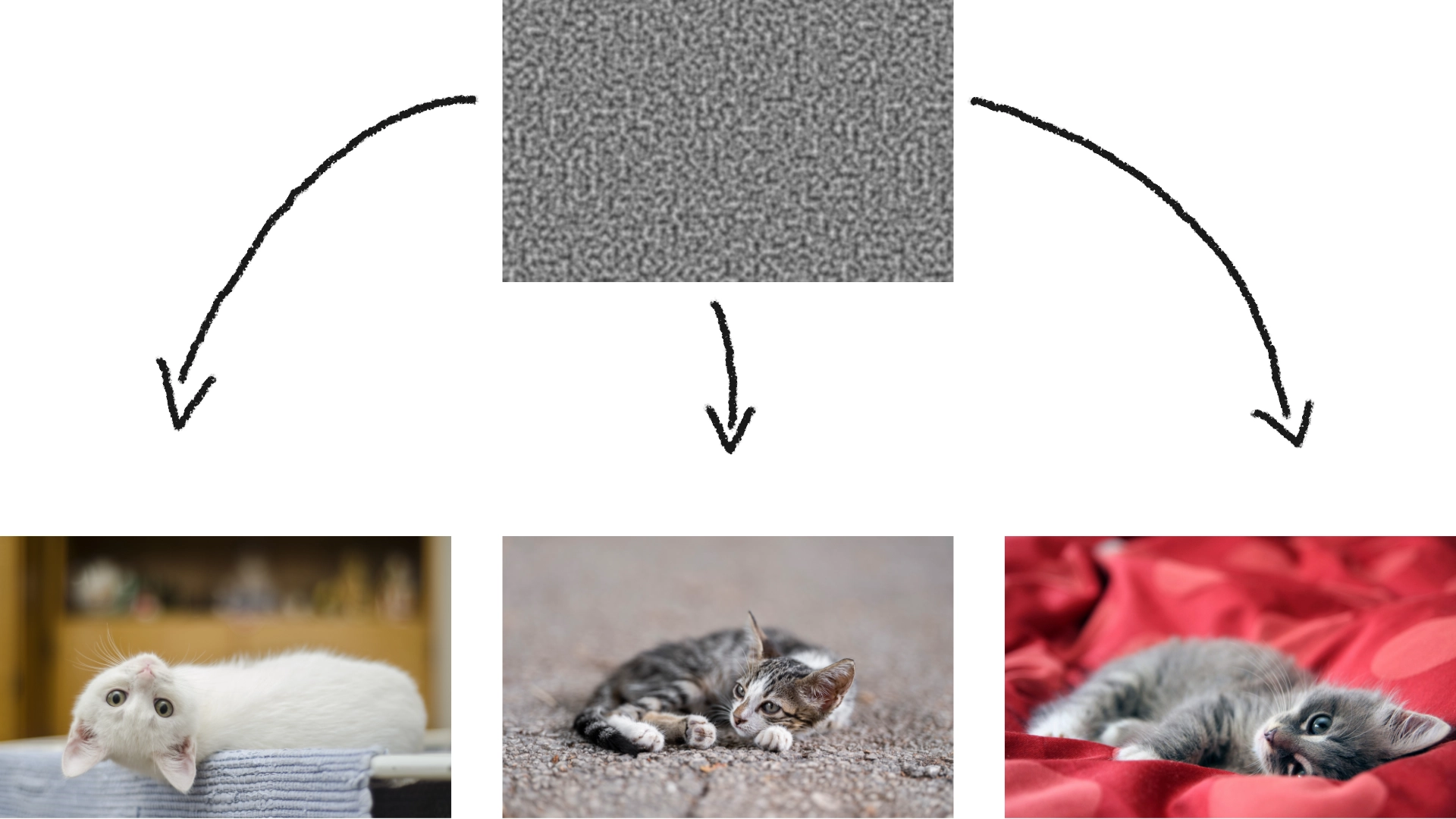
Without going into the technical details, these models have an element of "luck" that's impossible to remove. Type the same prompt 1,000 times and you'll get 1,000 different results (and that's true even with the most precise prompt possible).
So the basic math is wrong: you're not paying for a video, you're paying to have a chance of getting a video that looks like what you asked for. Every failed attempt drains your credits. Some "AI" projects end up costing thousands of euros in generation for a result that's... questionable.
The "cleanup": the step no one talks about
Once you have, by some miracle, a shot that suits you, you have to clean it up. An extra finger, an eye living its own life, a sound that doesn't fit... You then have to spend more credits on other models to try to fix it.
And to put it all together? AI still can't do anything decent. You'll have to learn editing or pay a professional to bring some coherence back to this pixel mush.
Bottom line: you may have saved on the "production", but you had to do the strategy, the script, the storyboard and the post-production yourself. For a result that's often "cheap".
The hidden cost: the audience's emotional response
This is where it gets really serious for your brand.
A recent study compared people's reactions to human music and AI-generated music. The finding is fascinating: people enjoy AI music (because it's trained on the top 1% of global hits) AS LONG AS THEY DON'T KNOW IT'S AI.
As soon as they're told the track is artificial, the emotional response drops radically. The brain disconnects.
Now, emotional connection is exactly what you're buying when you make an ad.
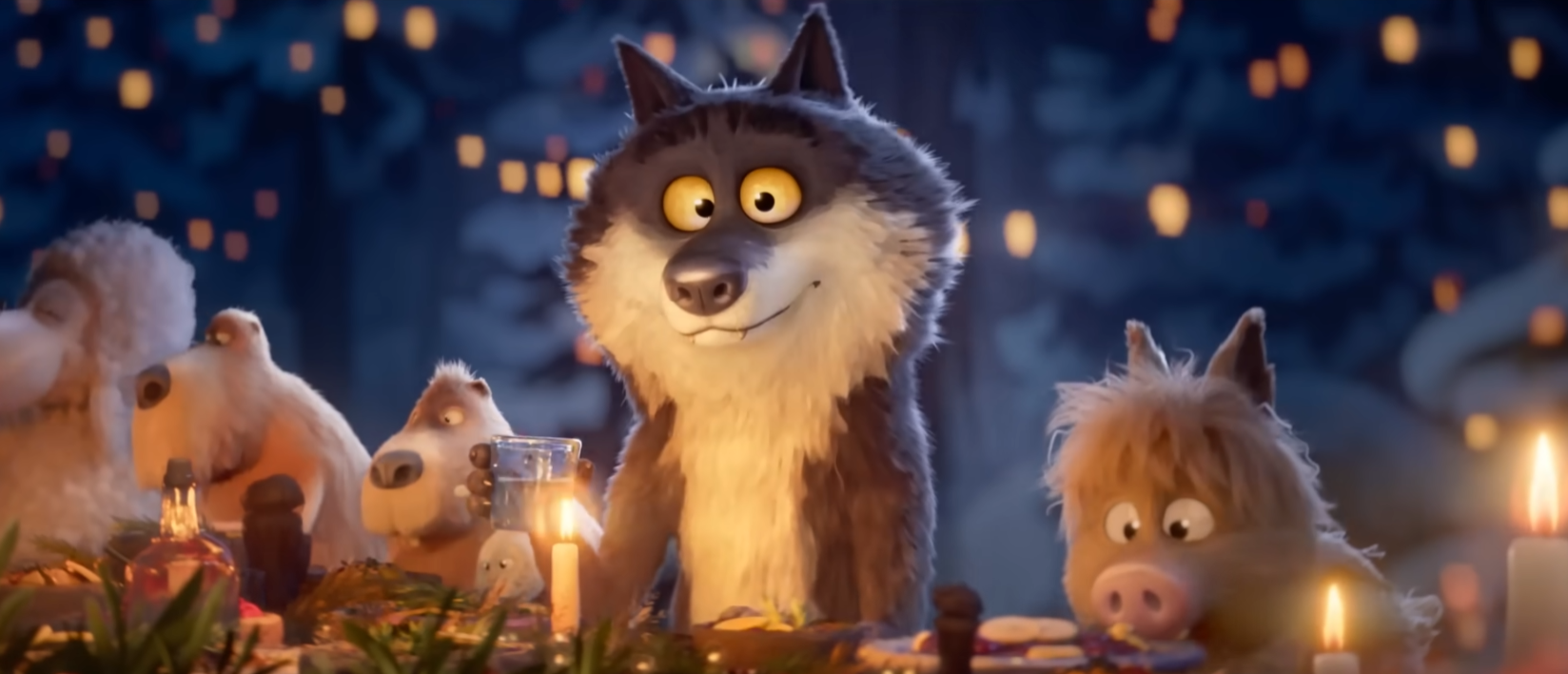
The textbook case: Coca-Cola vs. The Wolf
Look at the real impact:
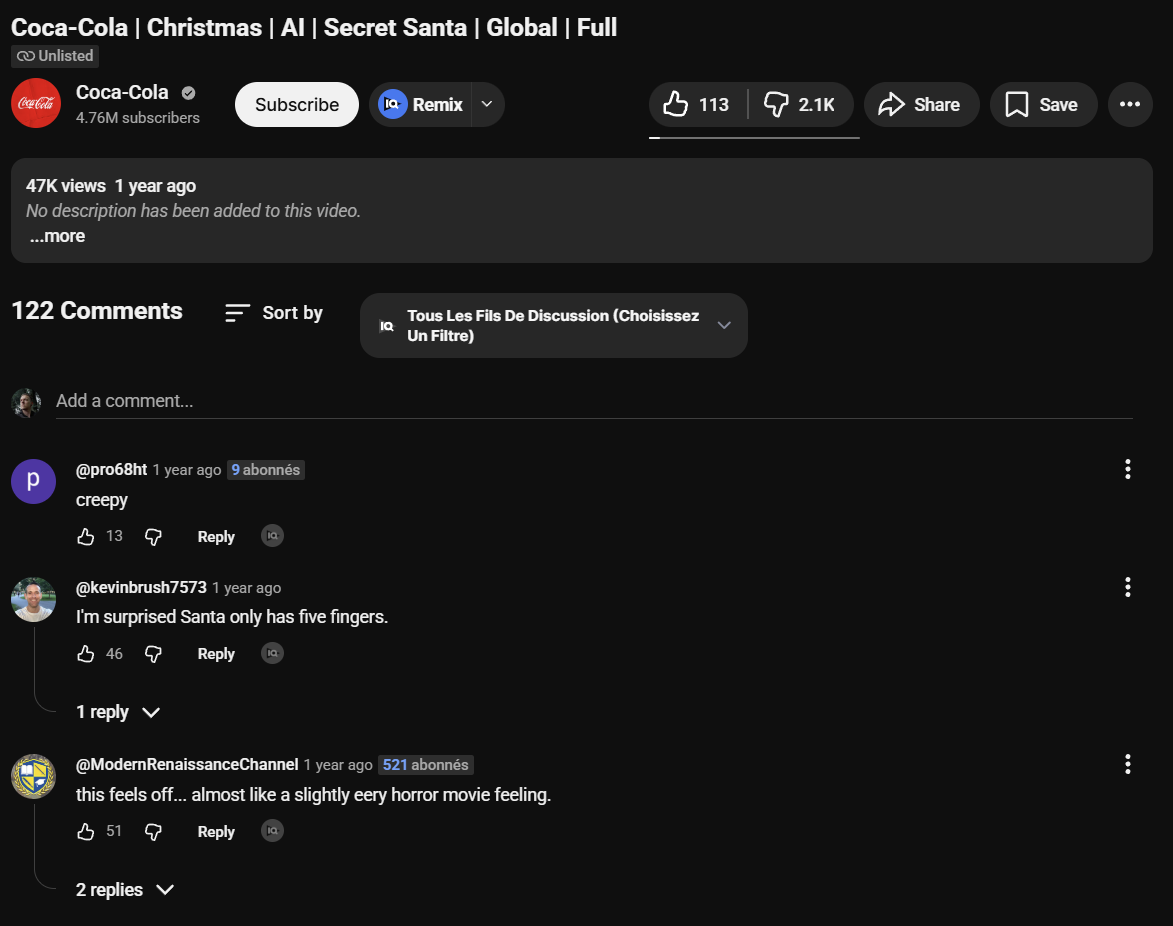
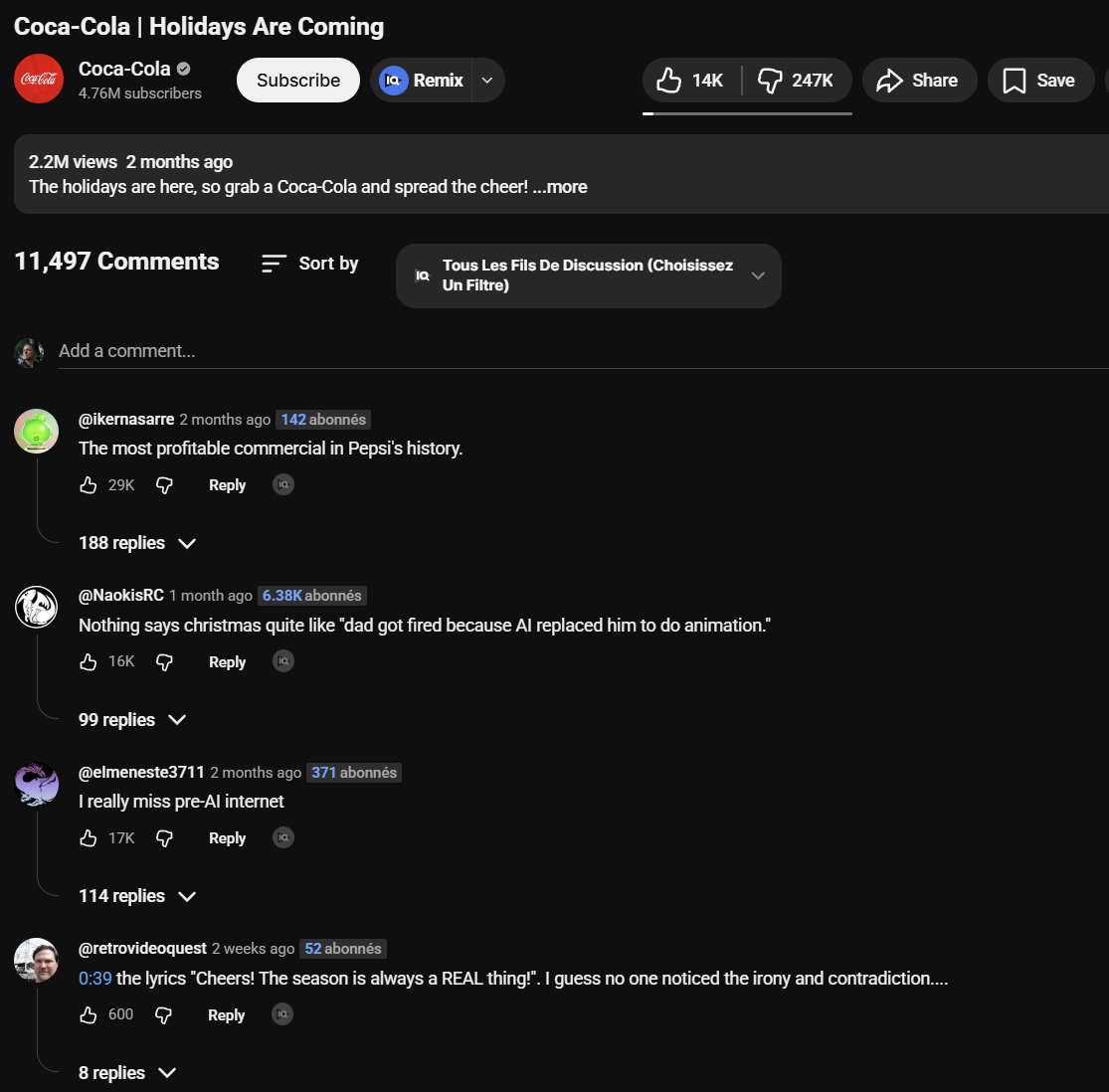
- Coca-Cola (Christmas 2024 & 2025): They went all-in on AI. The result? A record dislike rate on YouTube and a 2024 video switched to "unlisted" to hide the mess.
- McDonald's: They pulled their AI ad after just a few days following icy feedback from customers. (it's reposted here: https://www.youtube.com/watch?v=LYz-5cL-BhA )
The final dilemma of advertising made by generative AI in 2026
Today, you have two options:
- You mention the AI: And you risk immediate rejection or negative virality.
- You don't say it: And you hope no one notices the telltale details (Spoiler: they always end up being seen).
Conclusion: You may have saved a few euros on your production bill, but you lost your image to the "cheap" and the soulless. It's up to you to decide whether your brand deserves better than a roll of the dice.
Source:
https://journals.plos.org/plosone/article?id=10.1371/journal.pone.0326498
https://newsroom-deezer.com/2025/11/deezer-ipsos-survey-ai-music/